8-Day Great Migration: Ndutu Calving & Serengeti Explorer
Immerse yourself deeply in the calving season with three nights in Ndutu and two nights in the Serengeti.
TOUR OVERVIEW
Our most comprehensive calving migration safari. Spend three full nights on the Ndutu Plains at the height of the green season, followed by two nights in the Central Serengeti to track resident predators, ending with the spectacular Ngorongoro Crater floor. Designed for photographers and wildlife enthusiasts who want maximum time in the field.
An extensive eight-day itinerary offering the ultimate wildlife and photography experience during the wildebeest calving season in Ndutu and the Central Serengeti.
KEY EXPERIENCES
Tour Highlights
DAILY SCHEDULE
Day-by-Day Itinerary
Day 01Arrival in Arusha
Arrival in Arusha
You land at Kilimanjaro International, clear immigration, and find your guide waiting on the other side. The drive into Arusha takes about an hour. Outpost Lodge is the kind of place designed for exactly this: somewhere to shower, eat properly and sleep before an eight-day safari begins in earnest tomorrow.
Use the evening to sort your kit while you still can. Eight days in a vehicle rewards a little thought: a soft bag rather than a hard case, layers for cold crater mornings and hot afternoons at Ndutu, more memory cards than you think you need, and binoculars you have actually used before. Your guide will run through all of it over dinner.
Day 02Arusha to Ndutu Plains
Arusha to Ndutu Plains
An early departure heading southwest, gaining altitude through the Ngorongoro Conservation Area before descending onto the Ndutu plains on the far side. The route passes the Olduvai Gorge turnoff and there is usually time to stop. This is the ravine where the Leakeys found hominin remains that pushed human origins back nearly two million years.
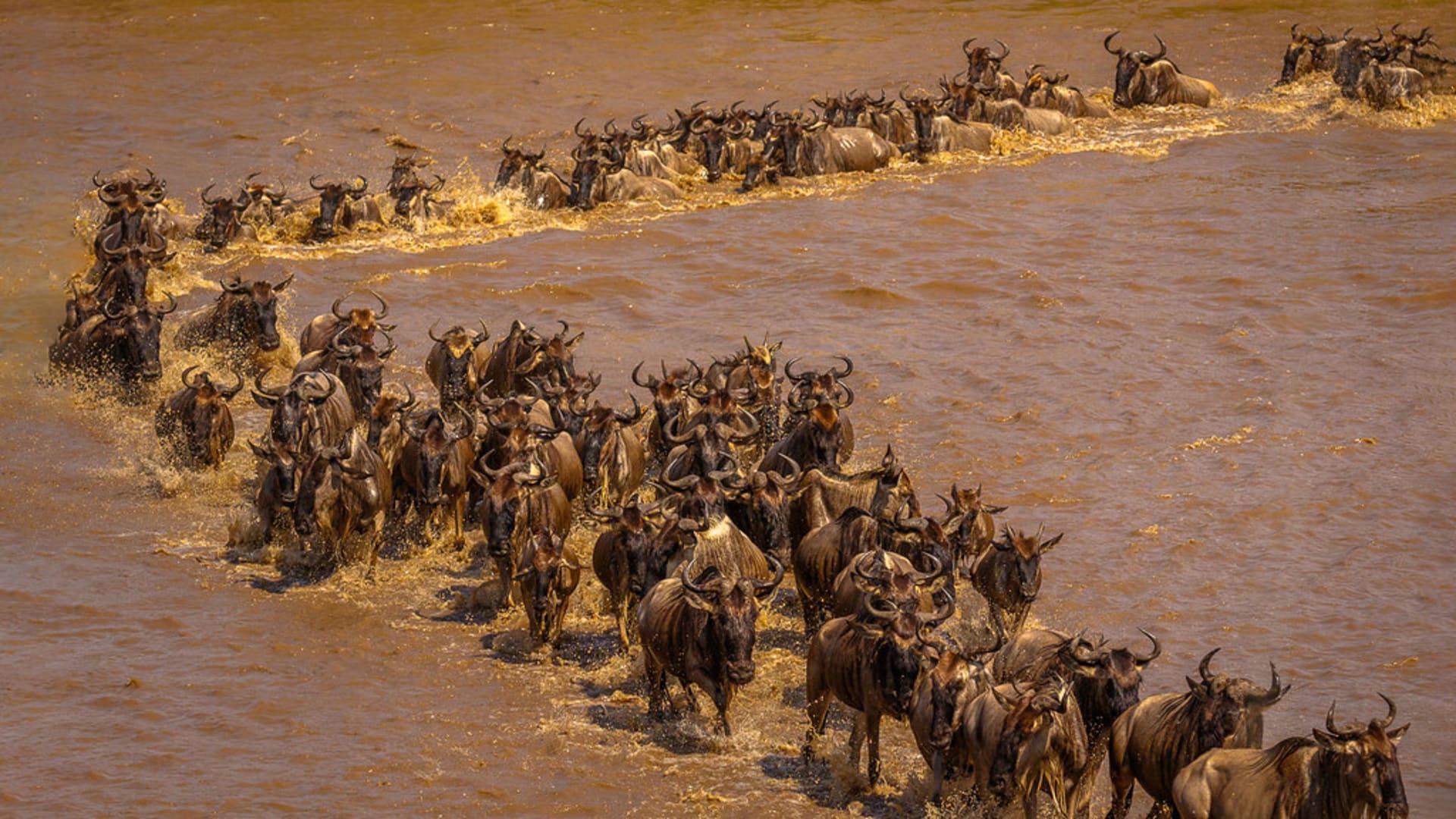
From Olduvai the country flattens and empties into short-grass plains. In calving season the last hour of this drive does the selling: wildebeest first in ones and twos, then in long files, then spread to the horizon in every direction with the noise of them carrying for kilometres.
Day 03Full Day on the Ndutu Plains
Full Day on the Ndutu Plains
A full day out on the plains with a packed lunch, moving among the herds rather than watching from the edge of them. Calving is at its peak now, and the arithmetic is remarkable: roughly eight in ten of the year's calves are born inside a three-week window, which is a strategy rather than a coincidence.
Flooding the plains with newborns all at once means the predators simply cannot eat them all. A calf is standing within minutes of birth and running with the herd inside the hour, and by sheer weight of numbers the great majority come through. Watching it happen is by turns extraordinary and hard going, and your guide will not pretend otherwise.
Day 04Ndutu Plains - Predator Tracking
Ndutu Plains - Predator Tracking
A second full day here, this one built around the predators. Your guide works the woodland edges and the marsh at first light, looking for the tracks and alarm calls that mean something is developing. Cheetah favour the open short grass where their speed counts, lion tend to use the acacia fringes and lake margins, and hyena clans stay active well past dawn.
The off-road permission at Ndutu is what makes a dedicated predator day worth having. Once a cheetah is found you can stay with her (for an hour, for three), and watch the whole sequence build: the sit, the stalk, the sprint. On a track-only day inside the national park you would be watching all of that from several hundred metres away.
Day 05Ndutu to Central Serengeti
Ndutu to Central Serengeti
You leave Ndutu after a final morning drive and work north through the Seronera Valley, game driving the whole way rather than treating it as a transfer. The plains gradually give over to acacia country, kopjes begin to appear on the horizon, and you reach Serengeti Heritage Camp with the afternoon still in hand.
The kopjes are worth understanding, because they explain a lot of what you will see. They are ancient granite outcrops left standing as the softer ground eroded away around them, and they trap water in their crevices, stay cooler than open ground, and give a lion a commanding view. Where you find a kopje, you very often find cats on top of it.
Day 06Full Day in the Central Serengeti
Full Day in the Central Serengeti
A full day working the Seronera area: resident lion prides, established leopard territories along the river, and the cheetah families that use the open ground either side. This is a different proposition from Ndutu: less spectacle, more depth. The animals here are known to the guides individually, and a good one will tell you which pride you are looking at and what became of it last season.
Seronera has permanent water, which is the whole explanation. While the migration sweeps through the ecosystem on its annual circuit, the game here has no reason to leave, so territories are held across generations. It is the most reliable big-cat country in Tanzania at any time of year.
Day 07Serengeti to Ngorongoro Crater Rim
Serengeti to Ngorongoro Crater Rim
A relaxed morning game drive as you begin the journey east, the road out of the park crossing country worth taking slowly. You climb steadily out of the Serengeti and back into the Ngorongoro Conservation Area, reaching Rhino Lodge on the forested rim during the afternoon.
The change across a single day's drive is significant. You start at around 1,500 metres on open plains in full heat and finish at 2,300 in montane forest with mist coming through the trees and a fire lit by evening. Elephant and buffalo use the forest around the lodge, so the after-dark escort to dinner is not a formality.
Day 08Ngorongoro Crater Safari and Return to Arusha & Departure
Ngorongoro Crater Safari and Return to Arusha & Departure
The final descent, 600 metres down the crater wall for a half-day safari on the floor. After a week of following animals across enormous distances, the crater is the opposite proposition: everything is here, permanently, in one bowl. Lion, elephant, buffalo, hyena and flamingo are near-certainties, and this is your best and last chance at black rhino. Picnic lunch by the hippo pool, then the drive back to Arusha.
Eight days is enough to have seen the ecosystem work as a system rather than a run of sightings: the herds moving to grass, the predators moving to the herds, and the crater sitting apart from all of it with a permanent population that never has to go anywhere.
What's Included
- •All airport transfers in Tanzania
- •Professional English-speaking safari guide
- •4x4 safari vehicle with pop-up roof and unlimited mileage
- •All national park entrance fees and crater service fee
- •Off-road driving permits in the Ndutu area
- •Full board accommodation as specified
- •Bottled water throughout the safari
- •Flying Doctor emergency evacuation insurance
Not Included
- •International flights to and from Tanzania
- •Tanzania visa fees
- •Travel insurance
- •Tips for guide and lodge staff
- •Alcoholic and premium beverages
- •Personal expenses and souvenirs