
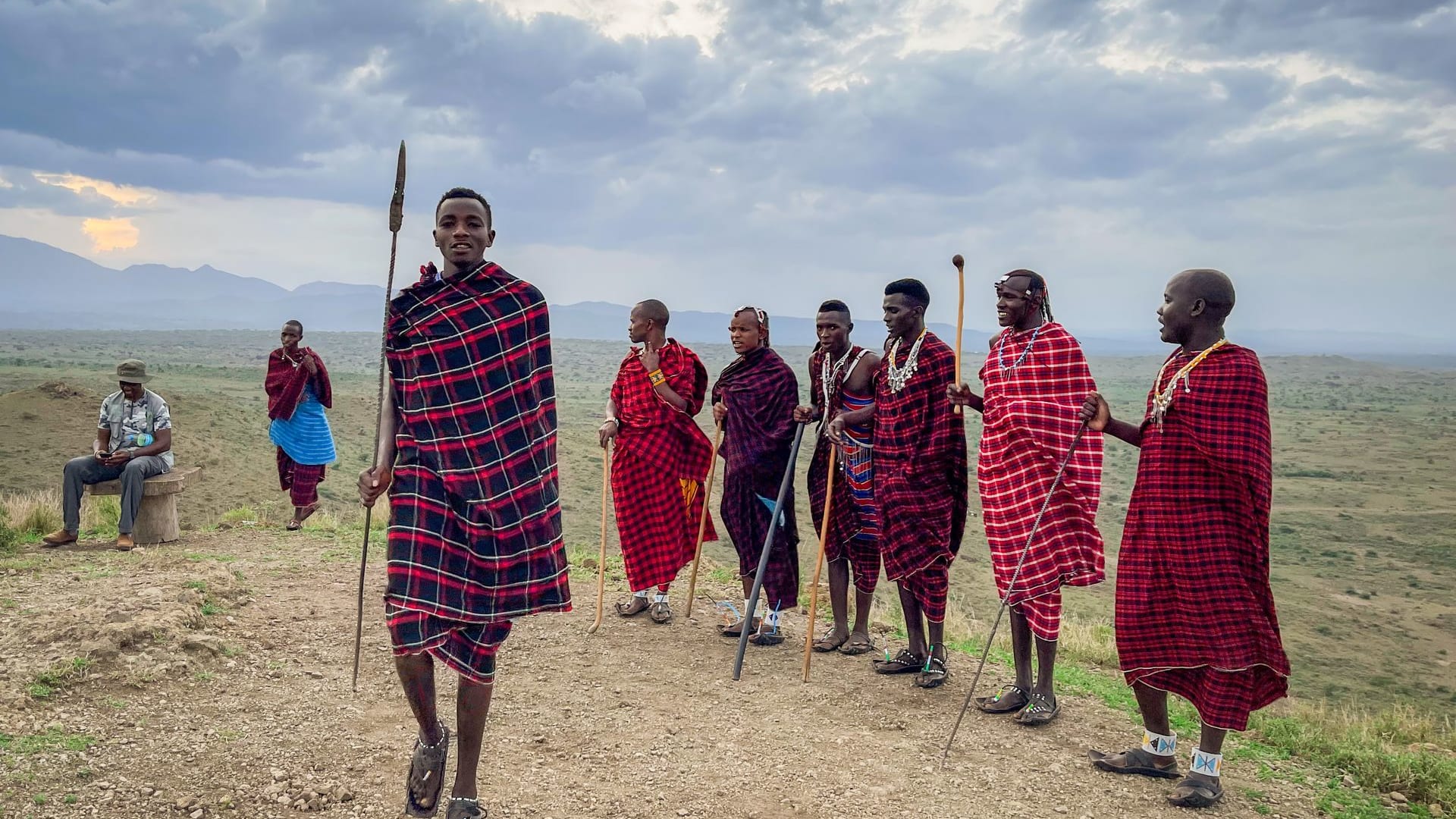
Tanzania has more than 120 ethnic groups and one shared language. Here's who you're likely to meet on a cultural visit, how to tell a real one from a staged performance, and how to behave when you get there.
Most safari itineraries treat culture as an afternoon. You stop at a village, someone dances, you take photographs, you leave. It is the part of the trip people are quietest about afterwards, because they suspect - correctly - that it was arranged for them.
It doesn't have to be that. But knowing the difference requires knowing something about the country first.
The short answer
Tanzania has more than 120 ethnic groups and no dominant one. Swahili holds them together. A good cultural visit is arranged with the community, paid for properly, and happens on their schedule - and you can tell within ten minutes which kind you're on.
One country, 120 languages
Tanzania is unusual in East Africa for how little ethnic politics shapes daily life, and that is largely deliberate. After independence, Swahili was adopted as the national language - a coastal trade language belonging to no single inland group, so no group's tongue was imposed on the others. Nearly everyone speaks it as a second language alongside their first.
The practical effect for a visitor is that Swahili is the polite thing to learn, not the language of any one people you'll meet. A greeting in Swahili works everywhere, from Stone Town to a Maasai boma.
Four greetings will carry you a long way:
- Jambo - hello, to anyone.
- Habari? - how are things? The expected answer is nzuri - good.
- Shikamoo - a respectful greeting to someone older than you. The reply is marahaba. Using this correctly will change how you are received, more than anything else you can do.
- Asante sana - thank you very much.
Who you're likely to meet
Cultural visits in the north cluster around the Rift Valley, Lake Eyasi and the Karatu highlands, because that is where four very different ways of living sit close together.
The Maasai - semi-nomadic pastoralists of the Rift Valley, and the group most visitors picture. Cattle are the centre of the economy and of status. A homestead - a boma - is a ring of houses inside a thorn enclosure, with the livestock brought inside at night. Much of what visitors are shown about the Maasai is real; much of what is sold about them is a costume. The difference is whether you are walking through a working homestead or standing in front of one.
The Hadzabe - hunter-gatherers living around Lake Eyasi, speaking a click language unrelated to its neighbours. They are one of the last groups in Africa still hunting and foraging as a primary way of living. A morning out with Hadzabe men involves walking fast, for a long time, usually before dawn, and often returning with nothing. If that sounds unglamorous, it is the honest version.
The Datoga - neighbours of the Hadzabe, pastoralists and, famously, blacksmiths. They work scrap metal into arrowheads and jewellery over simple furnaces, using goatskin bellows. The Hadzabe buy their arrowheads from them. It is a live trading relationship, not a museum.
The Iraqw - highland farmers around Karatu, growing coffee, maize and beans in some of the most fertile country in Tanzania. Their language is Cushitic - more closely related to languages of Ethiopia than to anything nearby. A visit here is agricultural rather than pastoral, and often the most relaxed of the four.
Staged or real: how to tell
This is the part nobody writes about, so here it is plainly.
Signs it was arranged for you:
- The dance begins as your vehicle arrives and ends when you leave.
- There is a fixed entry fee at a gate, paid to whoever is standing there.
- The visit is the same length regardless of what is happening that day.
- The crafts on sale are identical to those at the last three places you stopped.
- Nobody is doing anything except receiving you.
Signs it isn't:
- The visit was arranged in advance with named people, and they knew you were coming.
- Ordinary work carries on while you are there - milking, cooking, walking to water.
- Your guide translates conversation in both directions, rather than narrating at you.
- Some parts of the day are simply not available, because a family is busy.
- The payment is a matter of record, not a note handed over at a gate.
Our own cultural trips are built around the second column. The 5-Day Cultural Walking Safari walks between villages and stays in community-owned camps and homesteads, and the 7-Day Cultural Tanzania itinerary sets aside whole mornings rather than half-hour stops. Both are arranged with elders beforehand and compensated at agreed rates. That is the entire difference, and it costs more.
What the money does
Ask. A visit worth making has an answer.
Ours is: activities are arranged directly with the community and the fee is agreed with them in advance, not negotiated at the gate. It contributes to local schools and healthcare alongside what goes to the families you visit. When you buy something, the money goes to the person who made it.
You should expect that answer, or something equally specific, from any operator. "A portion of proceeds supports local communities" is not an answer - it is a sentence written to avoid giving one.
How to behave
Most of this is ordinary courtesy, but it is easier when someone has told you in advance.
- Ask before photographing anyone. Every time, including children. A camera pointed without asking is the single most common thing visitors get wrong. If the answer is no, that is the end of it.
- Greet before anything else. Greetings are not small talk in Tanzania; skipping them is what feels abrupt. Greet the oldest person present first.
- Use your right hand to give, receive, and eat. The left is considered unclean.
- Don't hand out sweets, pens or money to children. It seems generous and it teaches children to approach strangers for things. If you want to give, give through the community - your guide will tell you how.
- Dress modestly. Covered shoulders and knees in villages, and in Stone Town and along the coast, where most people are Muslim.
- Take your shoes off when entering a home, unless you are told otherwise.
- Buy directly. If you want a souvenir, buy it from the person who made it, and pay the asking price without hard bargaining in a place where you have been a guest.
What a cultural visit is not
- It is not a performance you are owed. If a family is busy, that is not a failure of the itinerary.
- It is not photography access. Some of the best moments are the ones you don't photograph.
- It is not charity. These are transactions between adults - you are paying for time and hospitality at an agreed rate. Treating it as a donation is its own kind of condescension.
- It is not a snapshot of "how Tanzania lives." Most Tanzanians live in towns, work ordinary jobs and watch football. Rural pastoralist life is one part of the country, not a summary of it.
- It is not an add-on. An hour tacked onto a game-drive day is the version people feel uncomfortable about later. Give it a morning at minimum.
Practicalities
- Timing - the dry months, roughly June to October and January to February, are easiest for walking and for road access to villages.
- Where - most northern cultural visits sit around Lake Eyasi, the Ngorongoro Conservation Area boundary, and Karatu. They combine naturally with Tarangire and the Crater.
- Language - your guide interprets. Ask them to translate your questions rather than answering on the community's behalf.
- Coastal culture is a different story - Swahili, Omani and Indian rather than pastoralist. That belongs with a Zanzibar trip, and Stone Town is where to see it.
If you want to do this properly
Look at the 7-Day Cultural Tanzania itinerary, which pairs Maasai, Hadzabe, Datoga and Iraqw visits with Tarangire and the Ngorongoro Crater, or the 5-Day Cultural Walking Safari if you would rather walk between villages than drive to them. For a single morning alongside a standard safari, our cultural tours run as half-day visits from Lake Eyasi and Ngorongoro.
Tell us how much time you want to give it and we will arrange it with the people you'll be visiting, in advance, at a rate they agreed to.
Tagged